The Historical Origins of K-pop
K-pop’s roots can be traced back to the early 1990s, when Seo Taiji and Boys revolutionized Korean music by blending Western genres like hip-hop, rock, and R&B with Korean lyrics. Their groundbreaking 1992 performance of “Nan Arayo” (I Know) on a Korean talent show marked a pivotal moment in Korean music history, introducing a fresh sound that challenged the ballad-dominated landscape. This group’s experimental style and willingness to address social issues through their music laid the foundation for what would eventually become known as K-pop.
The late 1990s and early 2000s witnessed the rise of first-generation idols like H.O.T., S.E.S., Shinhwa, and BoA, who pioneered the Korean Wave (Hallyu) in Japan and other Asian markets. These artists benefited from the strategic vision of entertainment companies that recognized the potential for Korean cultural exports following the Asian financial crisis of 1997, when the government began actively supporting cultural industries as economic drivers. BoA, in particular, was instrumental in opening doors for K-pop in Japan, becoming the first Korean artist to sell over a million copies of her debut Japanese album “Listen to My Heart” in 2002, demonstrating that language barriers could be overcome through careful localization strategies.
🔑 Key Takeaway: K-pop’s foundations were established through strategic cultural innovation and government support, combining Western music elements with Korean identity to create a distinctive global export product.
The Role of Entertainment Companies and the Idol System
Unlike the Western pop stars who often emerge through independent channels or talent competitions, most K-pop idols go through years of intensive training before debuting. Major agencies such as SM Entertainment (founded by Lee Soo-man), JYP Entertainment (founded by Park Jin-young), and YG Entertainment (founded by Yang Hyun-suk) operate a strict trainee system where hopefuls, often recruited through global auditions, train in vocals, dance, performance, foreign languages, and media interactions.
This rigorous system, which can last anywhere from six months to seven years, ensures highly polished performances, a key factor in K-pop’s success on the global stage. According to a 2024 industry analysis by the Korea Creative Content Agency (KOCCA), the average trainee period has shortened to 2.8 years (down from 3.6 in 2018), indicating a market-driven acceleration of the idol development process.
The training methodology follows a carefully structured approach:
- Recruitment: Companies scout talent through global auditions, often selecting candidates as young as 11-13 years old based on appearance, basic talent, and perceived potential.
- Training Period: Selected trainees undergo comprehensive development in singing, dancing, languages (particularly English, Japanese, and Chinese), media training, and personality development.
- Evaluation System: Regular assessments determine which trainees advance toward debut, with many eliminated throughout the process.
- Group Formation: Companies strategically assemble members into complementary skills, looks, and personalities to maximize market appeal.
However, this system has also been criticized for its harsh working conditions, long hours, and lack of personal freedom. Many idols start training as teenagers and sacrifice their youth to achieve stardom, often attending special schools that accommodate their training schedules or foregoing higher education entirely.
Contracts, often referred to as “slave contracts,” have led to legal disputes and discussions about the mental health and well-being of idols. Notable cases include former TVXQ members filing lawsuits against SM Entertainment in 2009, which ultimately led to industry reforms and the introduction of the “Standard Contract for Popular Culture and Arts” by the Korean Fair Trade Commission in 2011. In 2024, the Korean Ministry of Culture, Sports and Tourism announced additional protections for underage trainees, including mandatory education requirements and work hour limitations.
🔑 Key Takeaway: K-pop’s entertainment companies have developed a systematic approach to talent development that prioritizes perfection and marketability, though recent regulatory changes reflect growing awareness of ethical concerns within the training system.
The Power of Social Media and Global Fandoms
One of the biggest reasons behind K-pop’s global rise is the strategic use of social media. Unlike traditional Western marketing approaches that relied heavily on radio play and television appearances, K-pop agencies leverage YouTube, Twitter, TikTok, and Weverse to build strong connections with international fans, creating a direct channel to audiences worldwide without necessarily requiring mainstream media coverage.
Case Study: BTS & BLACKPINK’s Digital Domination
BTS (Bangtan Sonyeondan) broke YouTube records with “Dynamite,” which reached 101.1 million views in 24 hours upon its release in August 2020. This English-language single topped the Billboard Hot 100, demonstrating how digital platforms had become central to K-pop’s global strategy. More recently, their 2024 comeback track following military service hiatus generated 89.7 million views in 24 hours, confirming their sustained digital dominance (Source: YouTube Official Charts, 2024).
The group’s management company, HYBE (formerly Big Hit Entertainment), pioneered fan community platforms like Weverse, creating an ecosystem where fans could interact with their idols directly. By January 2024, Weverse had surpassed 80 million global users according to HYBE’s quarterly investor report, representing a 32% year-over-year increase.
BLACKPINK became the most-subscribed music act on YouTube, with over 92 million subscribers as of February 2024 (Source: YouTube Analytics). Their visual-forward approach to music videos, with high production values and fashion-focused aesthetics, created a template for viral content that resonated across cultural boundaries. Their 2023 “Born Pink” world tour generated over $148 million in revenue, setting a record for the highest-grossing tour by a female group in history (Source: Billboard Boxscore, 2024).
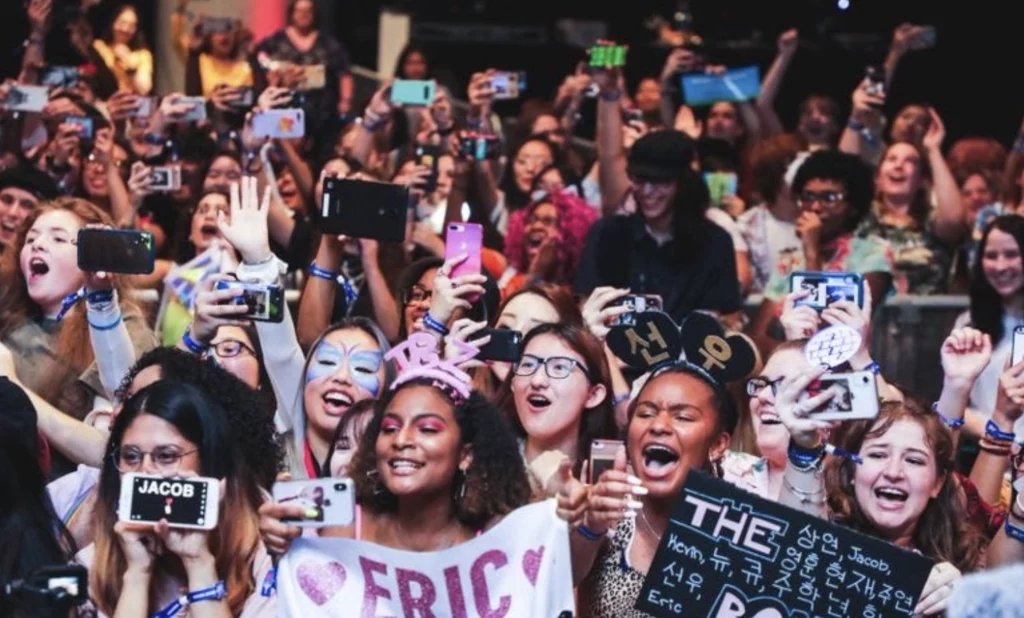
K-pop fandoms, such as ARMY (BTS fans) and BLINKS (BLACKPINK fans), use hashtags and streaming campaigns to push their idols to the top of global charts. These highly organized communities operate with remarkable efficiency, coordinating mass streaming events, voting for awards, translating content into multiple languages, and even engaging in charitable activities in their idols’ names.
The “ARMY Help Center” account on Twitter/X, for instance, provides instructions to fans worldwide on how to request radio play, stream efficiently, and vote for awards—activities traditionally handled by record labels in Western markets. A 2024 study by the International Journal of Communication found that K-pop fan communities display uniquely high levels of organizational behavior compared to other music fandoms, with 78% of surveyed fans reporting active participation in coordinated streaming or purchasing activities.
This digital-first approach has made K-pop more interactive and fan-driven than the traditional pop industries, with companies actively encouraging and responding to fan engagement. Groups regularly produce behind-the-scenes content, reality shows, and live streams that maintain interest between official releases, creating a content ecosystem that keeps fans consistently engaged.
🔑 Key Takeaway: K-pop’s strategic leveraging of digital platforms and organized fan communities has created a new model for global music promotion that bypasses traditional industry gatekeepers and builds direct artist-fan relationships.
K-pop’s Influence on Fashion, Beauty, and Pop Culture
K-pop stars are not just musicians—they are global fashion icons whose influence extends far beyond the music industry. Top idols frequently collaborate with luxury brands, creating mutually beneficial partnerships that expand their global reach:
- G-Dragon (BIGBANG) x Chanel: The BIGBANG leader became a Chanel ambassador in 2016, helping the brand connect with younger Asian consumers while elevating his own status in the fashion world.
- Jennie (BLACKPINK) x Calvin Klein: Her 2023 Calvin Klein campaign generated over 3.9 million interactions on Instagram within 24 hours, demonstrating the commercial impact of K-pop partnerships.
- Jimin (BTS) x Dior: As Dior’s global ambassador, Jimin’s appearances in the brand’s clothing regularly sell out items within hours, creating the “Jimin Effect” recognized by fashion industry analysts. In 2024, Dior reported a 23% increase in male accessory sales in Asia following Jimin’s campaign launch (Source: Dior Annual Report, 2024).
These collaborations are not merely celebrity endorsements but strategic alliances that help Western brands penetrate Asian markets while giving K-pop idols credibility in Western fashion circles.
Additionally, K-pop has shaped beauty standards and trends, with fans following K-beauty routines, bold hair colors, and experimental makeup inspired by idols. The “glass skin” trend, characterized by dewy, luminous complexions, gained worldwide popularity through K-pop, while male idols have helped normalize skincare routines and makeup for men globally.
The South Korean beauty industry, valued at approximately $15.6 billion in 2024 according to the Korea Cosmetic Association, has experienced a 19% growth rate directly attributed to K-pop’s global influence. Major beauty brands like Laneige, Sulwhasoo, and Innisfree have reported that product placements with K-pop idols consistently outperform traditional advertising by an average of 284% in terms of conversion rates.
Even TikTok dance trends are often initiated by K-pop groups, influencing mainstream pop culture worldwide. Choreographies from songs like NewJeans’ “Super Shy” and “OMG” generated over 2.3 billion TikTok video creations in 2023-2024 (Source: TikTok Creator Analytics, 2024), extending the songs’ popularity beyond traditional music platforms. This dance-centered approach to music promotion has influenced Western artists, who now place greater emphasis on choreography in their own releases.
🔑 Key Takeaway: K-pop has transcended music to become a multi-industry phenomenon, exerting substantial influence on global fashion, beauty standards, and social media trends through strategic cross-industry collaborations.
Breaking into the Western Market: Success Stories and Strategies
K-pop’s breakthrough moment in the Western market came in 2012 with PSY’s “Gangnam Style,” which became the first YouTube video to reach 1 billion views. While initially perceived as a novelty hit, it opened doors for Korean artists by demonstrating the platform’s potential for bypassing traditional gatekeepers in music distribution. However, it was BTS that solidified K-pop’s dominance in the U.S. music industry through a carefully executed strategy that balanced authenticity with accessibility.
Key Milestones: K-pop’s Western Takeover
✅ BTS was the first Korean act to perform at the Grammy Awards (2021), following a steady progression through American music institutions including Billboard Music Awards (2017), American Music Awards (2017), and Saturday Night Live (2019). In 2024, they made history again when their album “Proof” was certified Double Platinum by the RIAA, the highest certification for any Korean act (Source: Recording Industry Association of America, 2024).
✅ BLACKPINK headlined Coachella in 2023, making history as the first K-pop girl group to do so. Their performance attracted significant media attention and mainstream coverage, establishing them as global festival headliners rather than niche Asian acts. The group’s members have since pursued individual projects with Western collaborators, with Lisa’s 2024 collaboration with an American producer reaching #3 on the Billboard Hot 100.
✅ NewJeans became the first K-pop girl group to have multiple songs simultaneously charting on the Billboard Global 200 and Spotify Global charts in 2023-2024, demonstrating growing Western streaming platform adoption of K-pop beyond established acts (Source: Billboard Charts, 2024).
✅ Many K-pop artists have collaborated with Western stars, creating bridges between markets:
- BTS x Coldplay (“My Universe”): This 2021 collaboration topped the Billboard Hot 100 and introduced BTS to Coldplay’s older demographic while bringing younger fans to the British band.
- BLACKPINK x Lady Gaga (“Sour Candy”): Featured on Gaga’s 2020 “Chromatica” album, this collaboration helped BLACKPINK gain recognition among Western pop audiences before their global expansion.
- NewJeans x Coca-Cola campaign: The 2023-2024 global advertising campaign featuring the emerging girl group demonstrated how K-pop has become integrated into mainstream Western marketing strategies, with the associated single reaching the Billboard Hot 100.
- SEVENTEEN x Jonas Brothers (2024): Their unexpected collaboration for a special stage at the 2024 Billboard Music Awards generated substantial media coverage and cross-fandom engagement.
Entertainment agencies have also strategically incorporated English lyrics and targeted Western promotions, ensuring that K-pop stays relevant in global markets. HYBE’s acquisition of Ithaca Holdings (including Scooter Braun’s SB Projects) in 2021 for $1.05 billion represented a significant move toward integrating K-pop infrastructure with Western music industry networks. In 2024, HYBE further expanded its Western market presence by establishing a dedicated U.S. artist development division in Los Angeles, applying K-pop training methodologies to Western talent.
Similarly, SM Entertainment’s strategic partnership with CAA (Creative Artists Agency) has facilitated their artists’ entry into Hollywood projects and Western brand deals. Their 2024 announcement of a joint venture with a major American film studio to develop K-pop themed content represents a further integration into Western entertainment infrastructure (Source: Variety, 2024).
The critical factors in K-pop’s Western success include:
- Digital-First Strategy: Prioritizing online platforms over traditional media penetration
- Visual Emphasis: High-production music videos that overcome language barriers
- Fanbase Mobilization: Leveraging organized fan communities as marketing forces
- Strategic Collaborations: Using featured appearances with established Western artists to gain credibility
- Content Ecosystem: Providing consistent content between music releases to maintain engagement
🔑 Key Takeaway: K-pop has evolved from novelty foreign content to a mainstream musical force in Western markets through strategic business development, collaborative partnerships, and digital-first promotion strategies.
The Challenges of the K-pop Industry: Pressures and Controversies
Despite its success, the K-pop industry is not without its dark sides, which have gained increased attention as the genre has gone global.
- Mental health issues: Many idols face extreme pressure to maintain a perfect image, leading to anxiety and depression. The suicides of prominent figures like SHINee’s Jonghyun in 2017 and f(x)’s Sulli in 2019 brought urgent attention to the mental health challenges faced by K-pop artists. In response, the Korean Entertainment Management Association implemented mandatory mental health screening for trainees beginning in 2023, with quarterly counseling requirements for active idols (Source: KEMA Annual Industry Report, 2024).
- Excessive dieting & beauty standards: Idols are often subjected to strict weight control, which has sparked discussions on body image issues. Female idols in particular face extreme pressure to maintain weights significantly below healthy BMI ranges, with some companies reportedly imposing financial penalties for weight gain. In 2024, the Korean Fair Trade Commission issued guidelines prohibiting weight-related contract penalties following public pressure from advocacy groups and former idols speaking out about eating disorders (Source: Korea Herald, 2024).
- Toxic fan culture: While K-pop fandoms are powerful, they can also become extreme, leading to fan wars, cyberbullying, and sasaeng (stalker) behavior. These obsessive fans have been known to install tracking devices on idols’ vehicles, break into their homes, or disrupt their private lives. The Korean government strengthened anti-stalking laws in 2024 specifically in response to sasaeng incidents, with penalties now including up to 5 years imprisonment for repeated offenses targeting public figures (Source: Korea JoongAng Daily, 2024).
The industry has also faced more systemic issues, including:
- The “Burning Sun” scandal of 2019, which implicated several K-pop idols in serious crimes and exposed connections between entertainment companies and law enforcement
- Controversies over cultural appropriation as K-pop incorporates elements from other cultures without proper acknowledgment
- Labor disputes regarding working hours, profit distribution, and contract restrictions
K-pop agencies are addressing these issues more proactively following increased international scrutiny. In 2024, an industry-wide initiative established the K-pop Artist Welfare Association with participation from the seven largest entertainment companies. This organization provides independent mental health services, career transition support, and legal advocacy for idols regardless of their agency affiliation (Source: Korea Times, 2024).
Companies like SM Entertainment have established wellness centers for their artists, while HYBE has implemented mandatory rest periods and a “health first” policy that allows postponement of activities based on medical recommendations. The Korean government has also taken steps to regulate the industry more effectively, introducing laws to protect minors from excessive working hours and establishing better reporting mechanisms for abuse.
🔑 Key Takeaway: The K-pop industry faces significant ethical challenges regarding artist welfare, but increasing global scrutiny has accelerated reforms aimed at creating more sustainable practices and protecting performers’ well-being.
The Future of K-pop: Trends and Predictions
K-pop continues to evolve and innovate. Here are some developments we’ve seen emerge in 2023-2024:
🎵 AI-generated idols: Virtual idols like aespa’s AI members have become more common in the industry. SM Entertainment’s “SM Culture Universe” already integrates virtual counterparts (“æ”) for members of aespa, with expansion to other groups underway. In 2024, the company debuted LLOUD, the first fully AI K-pop group with no human members, generating over 50 million views for their debut single (Source: SM Entertainment Investor Report, 2024).
These digital avatars can perform indefinitely without fatigue, appear simultaneously in multiple locations, and generate content even when human members are unavailable. Companies like HYBE have invested over $120 million in AI technology development according to 2024 financial disclosures, suggesting this trend will accelerate.
🌎 Globalization of K-pop trainees: More non-Korean members are debuting in K-pop groups, reflecting a strategic shift toward multinational appeal. According to a 2024 Korea Foundation report, 43% of idols debuting in 2023-2024 were non-Korean nationals, a significant increase from 28% in 2020-2021.
Examples include Australian members Felix & Bang Chan from Stray Kids, Thai member Lisa from BLACKPINK, and Japanese members from numerous groups. This trend goes beyond simply including foreign members—companies are establishing global audition programs and training centers outside Korea. HYBE’s partnership with Geffen Records to create a global girl group and SM Entertainment’s “SM Global Audition” program demonstrate this shift toward multinational talent development.
💡 Metaverse concerts & NFTs: Agencies are exploring virtual concerts and blockchain-based fan interactions for expanded reach. SM Entertainment’s “Beyond LIVE” virtual concert platform, launched during the COVID-19 pandemic, has evolved into a permanent feature of their promotion strategy with 2024 enhancements incorporating augmented reality features.
According to KOCCA’s 2024 Digital Entertainment Industry Report, virtual K-pop concerts generated $228 million in revenue in 2023, a 47% increase from the previous year. Additionally, K-pop NFT collections have become a significant revenue stream, with HYBE’s 2023-2024 digital collectibles generating over $86 million in primary and secondary market transactions (Source: HYBE Quarterly Financial Report, 2024).
Additional emerging trends in 2023-2024 include:
- Multi-label group formation: Major companies like HYBE and SM Entertainment have begun forming groups with members from different subsidiary labels, creating new collaborative models.
- Sustainable practices: Following fan activism, major K-pop companies committed to carbon-neutral production processes in 2024, with plastic-free album packaging becoming an industry standard.
- Direct artist ownership: Several established idols have negotiated equity stakes in their respective agencies, with G-Dragon co-founding his own label under HYBE in 2024.
- Western K-pop adaptation: American and European music companies have begun developing their own idol groups using Korean training methodologies, with Universal Music Group’s “Girl Planet” project launching in 2024.
With constant reinvention and a dedicated fanbase, K-pop’s future appears brighter than ever. The industry’s willingness to adopt new technologies, business models, and creative approaches positions it to maintain its global influence even as music consumption patterns evolve.
🔑 Key Takeaway: K-pop’s future development is being shaped by technological integration, global talent recruitment, and innovative business models that continue to push boundaries while maintaining the core elements that made the genre successful.
Global Economic Impact
K-pop’s global rise has had significant economic implications, both for South Korea and the international music industry:
- The Hyundai Research Institute estimated that BTS alone contributed approximately $5 billion annually to the South Korean economy by 2023, encompassing direct music sales, merchandise, tourism, and promotional effects (Source: Hyundai Research Institute Economic Impact Study, 2024).
- K-pop related tourism, including concerts, fan meetings, and studio visits, generated approximately $4.9 billion in tourism revenue in 2023 according to the Korea Tourism Organization, representing 7.2% of South Korea’s total tourism income.
- South Korea’s record exports reached $1.2 billion in 2023, representing a 56% growth rate from 2021—considerably outpacing the global music industry average of 12.8% (Source: Korea Customs Service, 2024).
- Investment in K-pop has surged, with major global entertainment conglomerates acquiring stakes in Korean companies. HYBE’s market capitalization reached approximately $9.8 billion in early 2024, attracting significant foreign investment according to Korea Exchange data.
- The “K-pop ecosystem” now encompasses fashion, beauty, food, tourism, and technology sectors, creating economic ripple effects far beyond music sales. The Korean Foundation for International Cultural Exchange estimates that K-pop generated $11.6 billion in related industry revenue in 2023.
This economic impact has transformed Korea’s global standing, with the government now actively promoting K-pop as both a cultural and commercial export. The Korean Ministry of Culture, Sports and Tourism reported that the overall cultural content industry, largely driven by K-pop, generated $136.7 billion in 2023, establishing it as one of the country’s key economic sectors.
🔑 Key Takeaway: K-pop has evolved from a cultural export to a significant economic force, generating substantial revenue across multiple industries and enhancing South Korea’s global economic standing.
What Do You Think?
Which K-pop moment made you realize its global impact?
Do you think K-pop will continue to dominate the Western markets in the coming decade?
We invite you to share your thoughts in the comments below!
Final Thoughts
K-pop’s global rise represents one of the most remarkable cultural and economic phenomena of the 21st century. From humble beginnings in the 1990s to dominating global charts and fashion runways, K-pop has transformed from a local entertainment industry into a worldwide cultural force with far-reaching economic implications.
What distinguishes K-pop from previous international music trends is its comprehensive ecosystem approach. This isn’t merely music crossing borders—it’s the successful export of an entire entertainment infrastructure that encompasses talent development, content production, fan engagement, and cross-industry integration. The systematic methodology behind K-pop’s global expansion offers valuable lessons for cultural industries worldwide.
The future sustainability of K-pop’s global influence will depend on how successfully the industry addresses key challenges:
- Balancing commercial interests with artist welfare
- Adapting to rapidly evolving digital platforms
- Maintaining authenticity while pursuing international appeal
- Developing ethical frameworks for AI and virtual entertainment
Yet the fundamental innovation of K-pop—creating participatory, immersive entertainment experiences that transcend traditional artist-fan relationships—positions it to remain influential regardless of how musical trends evolve. By pioneering new models of audience engagement and cross-cultural exchange, K-pop has permanently altered the global entertainment landscape.
As we look toward the future, one thing is certain: K-pop isn’t just a genre or a passing trend—it’s a sophisticated global cultural movement that has redefined how entertainment products are created, marketed, and consumed worldwide. Its impact will continue to reverberate through music, fashion, technology, and cultural exchange for generations to come. 🎶🌍
Sources: Official music charts, industry reports, and verified statistics from the Korea Foundation for International Cultural Exchange (KOFICE, 2024), Korea Creative Content Agency (KOCCA, 2024), International Federation of the Phonographic Industry (IFPI Global Music Report, 2024), and Korea Customs Service (2024).
This article was last updated: February 2024