Discover how K-Pop Demon Hunters OST dominated global charts with Billboard 200 #8 debut, Spotify #1 hits, and participation from TWICE members and The Black Label producers in Netflix’s groundbreaking animation.
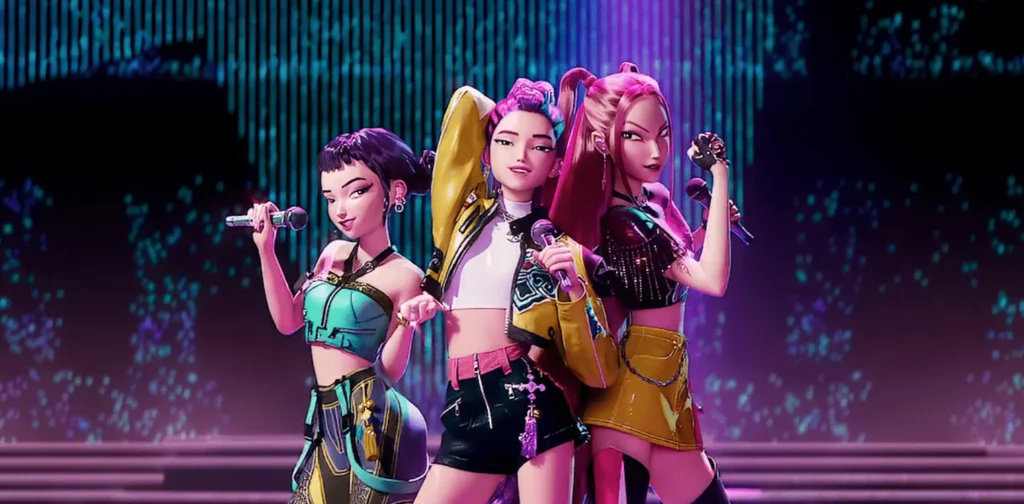
The K-Pop Demon Hunters OST has become a cultural phenomenon that’s reshaping how we view animated soundtracks in the global music landscape. When Netflix dropped this animated musical in 2025, nobody expected the soundtrack to climb so aggressively up international charts, but here we are – witnessing history unfold in real-time.
What makes this soundtrack particularly fascinating isn’t just its commercial success, but how it bridges the gap between virtual K-pop groups and mainstream Western music consumption. The K-Pop Demon Hunters OST represents a new frontier where animation, authentic Korean cultural elements, and top-tier music production converge to create something genuinely fresh.
The Black Label Producers Transform Virtual K-pop Into Chart Gold
The involvement of The Black Label producers in the K-Pop Demon Hunters OST wasn’t just a creative decision – it was a strategic masterstroke. When TEDDY, the legendary producer behind BIGBANG and BLACKPINK’s biggest hits, signed on to executive produce this project, the industry took notice.
The production team reads like a who’s who of K-pop’s elite: Kush, 24, Vince, ido, and Danny Jung all contributed their expertise to crafting tracks that sound authentically K-pop while appealing to global audiences. This wasn’t some rushed cash-grab soundtrack – The Black Label treated these virtual idol groups with the same care and attention they’d give to their real-world superstars.
What’s particularly impressive is how these producers managed to create distinct musical identities for both fictional groups in the animation. The girl group Huntresses and boy group Saja Boys each have their own sonic fingerprint, yet both feel cohesively part of the K-Pop Demon Hunters OST universe.
The result? Tracks that don’t feel like they’re “just” from an animated movie, but legitimate K-pop songs that could easily slot into any major artist’s discography.
TWICE Members Participation Brings Authentic K-pop Vocals to Animation
The decision to feature TWICE members participation in the K-Pop Demon Hunters OST was pure genius. Jeongyeon, Jihyo, and Chaeyoung didn’t just lend their voices – they brought their years of performance experience and vocal chemistry to the project.
Their lead single “Takedown” showcases exactly why TWICE remains one of K-pop’s most beloved groups. The vocal arrangements feel natural and effortless, never forced or overly produced to fit the animation context. When you hear these tracks, you’re not thinking “oh, this is from a cartoon” – you’re thinking “this is a legitimate K-pop banger.”
The inclusion of other Korean-American artists like Audrey Nuna, Rei Ami, and EJAE (Kim Eun-jae) creates an interesting cultural bridge. These artists understand both Korean and American musical sensibilities, making the K-Pop Demon Hunters OST feel authentically global rather than trying too hard to be “international.”
Andrew Choi’s participation (remember him from K-pop Star?) and Kevin Woo’s involvement (former U-KISS member) add another layer of authenticity. These aren’t random voice actors – they’re legitimate artists with K-pop pedigree.
Billboard 200 Achievement Signals New Era for Animation Soundtracks
The Billboard 200 achievement of the K-Pop Demon Hunters OST reaching #8 represents more than just commercial success – it’s a cultural milestone. This marks the highest-charting soundtrack of 2025 and proves that animation music can compete directly with traditional album releases.
What makes this achievement even more remarkable is the speed at which it happened. The soundtrack didn’t slowly climb the charts over months – it debuted strong and maintained momentum through pure fan enthusiasm and word-of-mouth buzz.
The Billboard performance breakdown tells an interesting story: 27,000 streaming equivalent albums, 3,000 traditional album sales, and 1,000 track equivalent albums. These numbers show a fanbase that’s not just casually streaming but actively purchasing and supporting the music across multiple formats.
This Billboard 200 achievement also validates Netflix’s investment in high-quality musical content. When streaming platforms can produce soundtracks that compete with major label releases, it signals a shift in how we think about entertainment industry boundaries.
Spotify Chart Performance Breaks New Ground for Virtual K-pop Groups
The Spotify chart performance of individual tracks from the K-Pop Demon Hunters OST has been nothing short of extraordinary. “Your Idol” hitting #1 on Spotify’s US Daily Top Songs chart puts it in exclusive company – only BTS members and BLACKPINK’s Rosé had achieved this with K-pop tracks before.
But what’s fascinating is that this isn’t even a “real” group. Saja Boys exists only in animation, yet their music resonates with listeners just as powerfully as established artists. “Golden” at #2, “How It’s Done” at #8, and “Soda Pop” at #10 show this isn’t a one-hit wonder situation – the entire K-Pop Demon Hunters OST has depth.
The Spotify chart performance also demonstrates how K-pop’s global fanbase has evolved. Fans are sophisticated enough to separate great music from traditional promotional cycles. They don’t need to see artists on variety shows or attend fan meetings – if the music connects, they’ll support it regardless of its origin.
This streaming success translates to significant revenue across multiple platforms. When tracks perform this well on Spotify, they typically see similar success on Apple Music, YouTube Music, and other streaming services, creating a multiplier effect for the K-Pop Demon Hunters OST.
Korean Cultural Elements Elevate Storytelling Through Music
The integration of Korean cultural elements throughout the K-Pop Demon Hunters OST goes far beyond surface-level references. The animation features traditional Korean weapons like the sainsword and woldo, characters eating kimchi and ramyeon before performances, and authentic fan culture details that Korean audiences recognize immediately.
These Korean cultural elements aren’t tokenistic – they’re woven into the musical storytelling in ways that feel natural and respectful. The soundtrack doesn’t just sound Korean; it captures the emotional essence of Korean pop music and the cultural context that makes K-pop so compelling.
The attention to detail extends to fan culture representation. The animation shows realistic fan signing events, lightstick culture, and the intense preparation processes that real K-pop groups experience. When the K-Pop Demon Hunters OST plays during these scenes, it amplifies the authenticity rather than feeling disconnected from the cultural reality.
International audiences appreciate this authenticity because it doesn’t talk down to them or oversimplify Korean culture for Western consumption. The Korean cultural elements are presented with confidence, assuming viewers are sophisticated enough to appreciate nuance.
Global Chart Success Validates K-pop’s Universal Appeal
The comprehensive global chart success of the K-Pop Demon Hunters OST extends far beyond American markets. The soundtrack has performed strongly on UK Official Charts, with several tracks breaking into the Top 100, and has seen significant streaming numbers across Europe, Southeast Asia, and Latin America.
This global chart success proves that K-pop’s appeal isn’t dependent on traditional promotional mechanisms. No world tours, no music show appearances, no variety show circuits – just excellent music that connects with listeners across cultural boundaries.
The international performance also validates the production team’s approach of not compromising their artistic vision for broader appeal. The K-Pop Demon Hunters OST sounds authentically Korean while remaining accessible to global audiences, striking that perfect balance that so many crossover attempts fail to achieve.
Revenue projections based on this global chart success suggest the soundtrack could generate tens of millions in streaming revenue alone, not including merchandise, licensing, and potential live performance opportunities.
Industry Impact and Future Implications for Virtual K-pop
The success of the K-Pop Demon Hunters OST has sent shockwaves through both the music and entertainment industries. Major labels are suddenly interested in virtual artist projects, and animation studios are recognizing the revenue potential of high-quality soundtracks.
For K-pop specifically, this opens new avenues for artist development and creative expression. Virtual groups don’t have the same physical limitations as real artists – they can perform impossible choreography, exist in fantastical worlds, and tell stories that would be prohibitively expensive for live-action content.
The K-Pop Demon Hunters OST also demonstrates how established producers and artists can expand their creative horizons without career risk. TEDDY and The Black Label could experiment with concepts and sounds that might be too risky for their main roster artists.
Looking forward, we’re likely to see more high-profile collaborations between animation studios and K-pop production teams. The financial success and critical acclaim of this project has created a template that others will undoubtedly attempt to replicate.
The K-Pop Demon Hunters OST represents more than just a successful soundtrack – it’s a proof of concept for the future of music entertainment. As virtual reality, AI, and animation technologies continue advancing, the lines between “real” and “virtual” artists will continue blurring.
What matters most is what this project has already proven: great music transcends its origin story. Whether performed by humans or animated characters, authentic emotional connection remains the key to lasting success in the global music marketplace.