K-protest culture has emerged as the latest global Korean cultural export, showcasing how creative, peaceful demonstrations combine political expression with humor and festival-like atmosphere that captivates international audiences. This distinctive approach to civic action joins K-pop, K-dramas, and K-beauty as another fascinating aspect of Korean cultural influence worldwide.
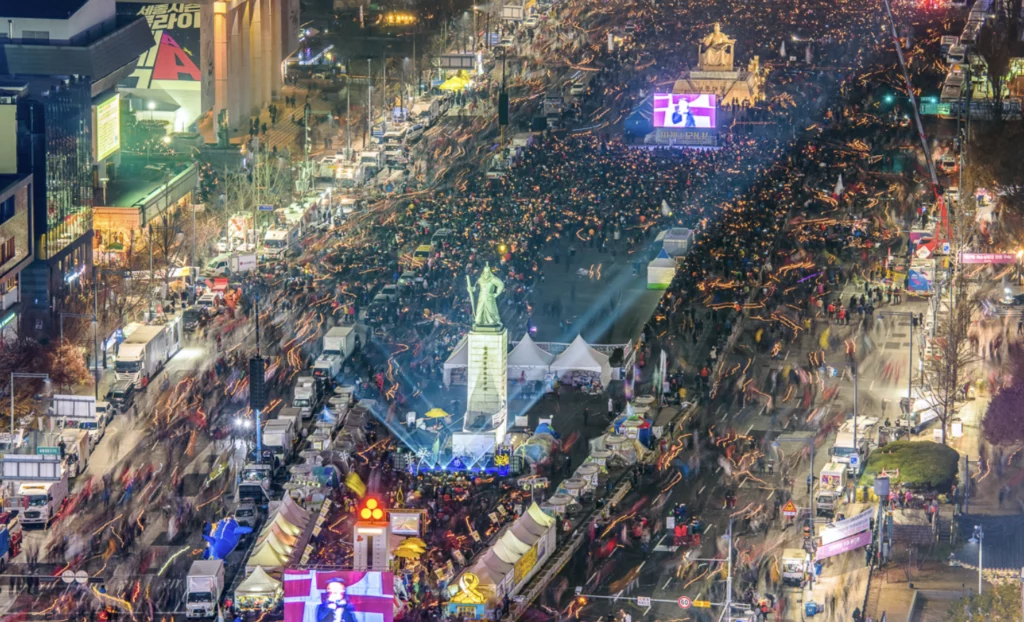
The Festival-Like Atmosphere of Korean Protests
The recent political demonstrations in South Korea have garnered international attention not just for their political significance but for their remarkably peaceful and creative nature. What sets Korean protests apart from demonstrations in many other countries is their festival-like atmosphere, where citizens express serious political concerns while maintaining a sense of community celebration.
During recent protests in Seoul, participants brought colorful light sticks typically used at K-pop concerts, created humorous signs with cultural references, and organized synchronized group activities reminiscent of fan events. International news outlets have highlighted how these demonstrations combine serious political messaging with elements of entertainment culture, creating what some journalists have called “protest concerts.”
Several foreign correspondents have noted the stark contrast between Korean protests and the often confrontational demonstrations seen in other countries. The New York Times published an article titled “Memes, Jokes, and Cats” that explored how Korean protesters use humor and satire as political tools, building solidarity through shared laughter even in tense political moments.
Creative Expression as Political Statement
What makes Korean protest culture truly distinctive is its emphasis on creative expression. Protesters often craft elaborate satirical props, wear imaginative costumes, and display witty signage that combines political messaging with pop culture references and wordplay.
During major demonstrations, it’s common to see protesters carrying signs with non-existent organizations like “Dumpling Association” or “Cat Lovers for Democracy,” using absurdist humor to make serious points about political participation. This approach creates a disarming atmosphere that both diffuses tension and amplifies the impact of the underlying message.
The creative elements aren’t merely decorative – they serve strategic purposes. The humorous and artistic expressions make protests more approachable and inclusive, allowing citizens who might feel intimidated by traditional political activism to participate. Additionally, the visually striking and often amusing nature of these demonstrations makes them highly shareable on social media, extending their reach beyond physical attendance.
Professor Lee Ki-hoon of Yonsei University has explained that these satirical flags demonstrate public anger toward perceived authoritarianism while maintaining a uniquely Korean approach to political expression. The mixture of serious political demands with creative presentation reflects a sophisticated understanding of how to make political messages both accessible and memorable.
The Historical Roots of Korean Protest Culture
Today’s creative protest culture didn’t emerge from nowhere – it has deep historical and cultural roots in Korean society. Traditional Korean art forms like pansori (narrative singing), talchum (mask dance), and various folk performances have long incorporated social criticism and political commentary through satire and humor.
These traditional forms of expression allowed ordinary people to critique power structures and social injustice in coded ways that avoided direct confrontation while still communicating dissent. The use of humor, exaggeration, and performance as political tools has a centuries-long history in Korean culture that continues to influence contemporary protest methods.
The modern incarnation of this protest style began taking shape during the democratic movements of the 1980s but truly blossomed during the 2016-2017 candlelight protests that led to President Park Geun-hye’s impeachment. These demonstrations saw millions of Koreans gather peacefully week after week, combining serious political demands with creative cultural expression.
These protests demonstrated that political action could be both powerful and peaceful, establishing a template that subsequent demonstrations have followed and refined. The candlelight protests showed that effective political demonstrations didn’t need to be confrontational or destructive – they could be communal celebrations of democratic values.
K-Protests as Tourist Attractions
Perhaps the most surprising development in Korean protest culture is how these demonstrations have become tourist attractions for international visitors. Travel agencies in Seoul now offer “K-Protest Tours” for foreigners curious to witness this unique cultural phenomenon firsthand.
Foreign tourists express amazement at both the scale and the peaceful nature of Korean protests. A Dutch tourist interviewed by a local newspaper remarked on how orderly the protests were compared to similar political events in Europe. American visitors frequently comment on the absence of violence or property damage, which stands in stark contrast to political demonstrations in many Western countries.
The organized, non-violent nature of these gatherings makes them accessible to tourists in a way that would be unthinkable in countries where protests frequently escalate into confrontations with authorities. For many visitors, attending a Korean protest has become an authentic cultural experience that offers insights into Korean society beyond the typical tourist activities.
Tourism industry representatives report that some international visitors specifically plan their trips to coincide with announced demonstrations, seeing them as opportunities to witness Korean democracy and culture in action. One tour guide noted, “Visitors are fascinated by how Koreans combine serious political expression with elements of entertainment and creativity.”
Social Media and the Global Spread of K-Protest Culture
The highly visual and creative nature of Korean protests makes them ideal content for social media platforms. Images of clever signs, artistic performances, and peaceful mass gatherings regularly go viral internationally, spreading awareness of Korean protest culture to global audiences.
This social media presence has helped establish Korean protest methods as a distinct cultural export alongside K-pop, K-dramas, and K-beauty. International activists and democracy advocates have begun studying and adapting elements of Korean protest culture for use in their own contexts, recognizing the effectiveness of combining serious political messaging with creative, peaceful demonstration techniques.
The hashtag #KProtest has gained traction on platforms like Twitter, Instagram, and TikTok, with users sharing images and videos of creative protest elements. This digital documentation helps spread Korean protest techniques and aesthetics globally while also preserving them as part of Korea’s cultural heritage.
Digital technology doesn’t just document protests – it helps organize them. Mobile messaging apps facilitate coordination among protesters, allowing for synchronized activities that enhance the visual impact of demonstrations. This technological sophistication further distinguishes Korean protests and contributes to their effectiveness.
The Impact of K-Protest on International Perceptions
The distinctive nature of Korean protests has significantly influenced international perceptions of Korean society and politics. Foreign media coverage frequently expresses admiration for the peaceful, orderly, and creative demonstrations, contrasting them favorably with protests in other countries.
This positive coverage has helped shape the international image of South Korea as a vibrant democracy with high levels of civic engagement. While K-pop and K-dramas have established Korea’s creative and entertainment credentials globally, the protest culture demonstrates the country’s democratic values and political sophistication.
International political scientists and democracy advocates increasingly cite Korean protest culture as a model for effective civic action. The combination of mass participation, clear political messaging, and peaceful, creative expression offers valuable lessons for democracy movements worldwide.
The protest culture has become an unexpected but significant component of Korea’s soft power, complementing its cultural exports and technological achievements. Through their distinctive approach to political expression, ordinary Korean citizens have become cultural ambassadors, showcasing Korean values and creativity to global audiences.
Learning from K-Protest Culture
What makes Korean protest culture worthy of study isn’t just its creative elements but its effectiveness. The peaceful mass demonstrations have repeatedly achieved significant political outcomes without the violence or property destruction that often characterizes protests in other countries.
The 2016-2017 candlelight protests successfully led to the impeachment of a president through entirely peaceful means. More recent demonstrations have continued to influence political decisions and public discourse while maintaining the same non-violent approach.
This effectiveness challenges the notion that protests must be confrontational or destructive to achieve political impact. The Korean model demonstrates that creativity, humor, and communal celebration can be powerful tools for democratic expression and political change.
For international observers interested in democratic movements and civic engagement, Korean protest culture offers valuable insights into how political expression can be both powerful and peaceful. The combination of serious purpose and creative implementation represents a distinctively Korean contribution to global democracy.
Conclusion: K-Protest as Cultural Heritage
Korean protest culture represents a unique fusion of traditional Korean cultural elements with contemporary political expression and digital technology. Like other Korean cultural exports, it combines distinctively Korean characteristics with universal appeal, allowing it to resonate with international audiences.
As Korea continues to increase its global cultural influence, the creative and peaceful nature of its protest culture stands as another example of the country’s unique approach to blending tradition with innovation. What began as a specific response to local political circumstances has evolved into a cultural practice with international recognition and influence.
For visitors to Korea interested in experiencing authentic aspects of Korean culture, attending a peaceful demonstration offers insights that tourist attractions alone cannot provide. The creativity, community spirit, and democratic values displayed at these events reveal important dimensions of contemporary Korean society.
The evolution of K-protest culture demonstrates how political expression itself can become a cultural export, influencing international perceptions and practices. As another facet of the Korean Wave, the distinctive protest culture further establishes Korea’s place as a global cultural innovator.